
What are Marine Assessments
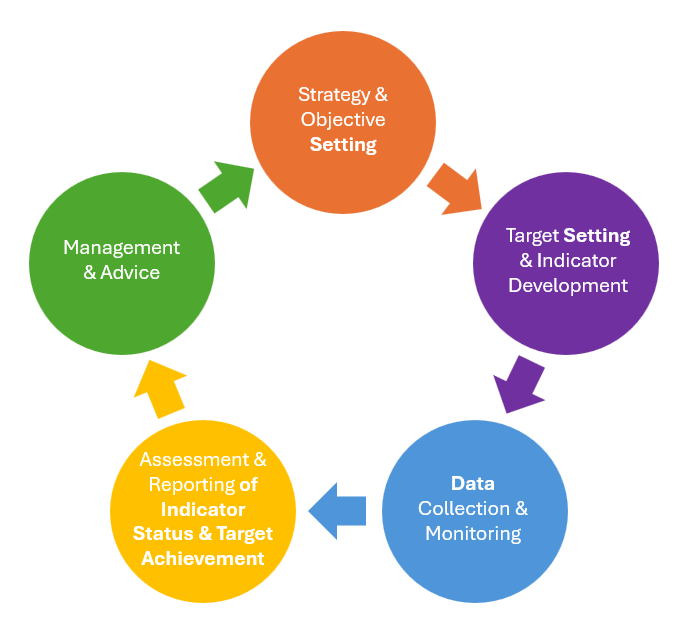
Marine Assessments are a vital step within the environmental management cycle (see figure above) that enables us to provide advice on management and inform policy. Marine Assessments rely on environmental and biological data from monitoring activities and on information on human activities and pressures acting on marine species and habitats.
Assessments take place at various spatial scales (e.g. MPA scale, UK scale, whole regions such as the Greater North Sea) and are driven by reporting requirements both at national and international level (see e.g. international conventions).
JNCC plays a key role in the development of indicators used to undertake marine assessments, working collaboratively with other experts nationally and internationally.
In relation to marine biodiversity, JNCC experts lead on the development and implementation of indicator assessments for marine mammals, marine birds, and benthic habitats. For more information, see dedicated page on marine biodiversity indicators.


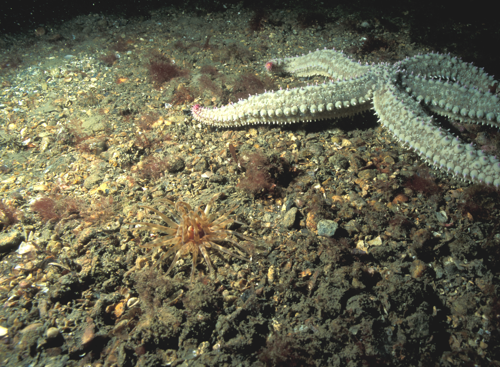
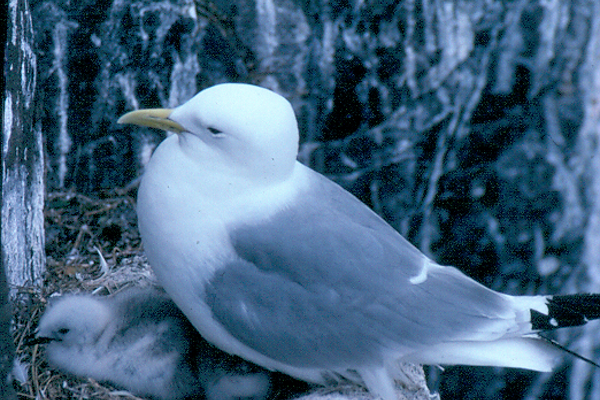
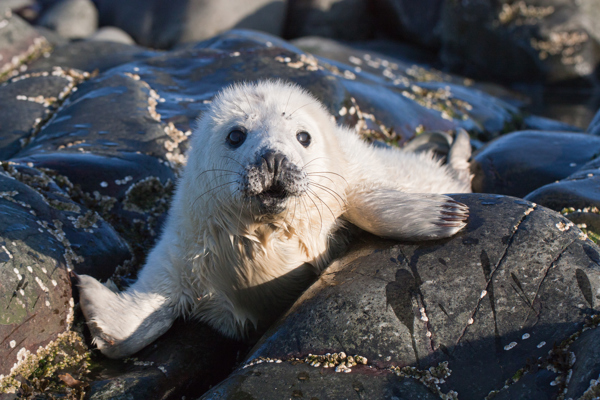
JNCC utilises a suite of indicators to support national and international reporting obligations, including the UK Marine Strategy, the OSPAR Convention and the Environmental Indicator Framework. These indicators provide robust evidence on the state of the marine environment, key pressures and ecosystem responses, enabling the UK to meet statutory obligations and track progress against long-term environmental goals. Where possible, JNCC aligns indicator development and application across these frameworks to ensure coherence between national and international reporting requirements and to strengthens the evaluation of marine environmental status.
UK Marine Strategy
The UK Marine Strategy sets out how will we achieve the vision of clean, healthy, safe, productive and biologically diverse oceans and seas. It is made up of three parts setting out a comprehensive framework for assessing (Part 1), monitoring (Part 2) and implementing measures (Part 3) for the protection and management of UK seas.
JNCC helps to implement the UK Marine Strategy and assess progress made towards Good Environmental Status by leading, in collaboration with other organisations, the development of indicators and targets to assess biodiversity.
For further information on the latest UK Marine Strategy Part 1 on the assessment of progress towards Good Environmental Status, visit the Marine online assessment tool.
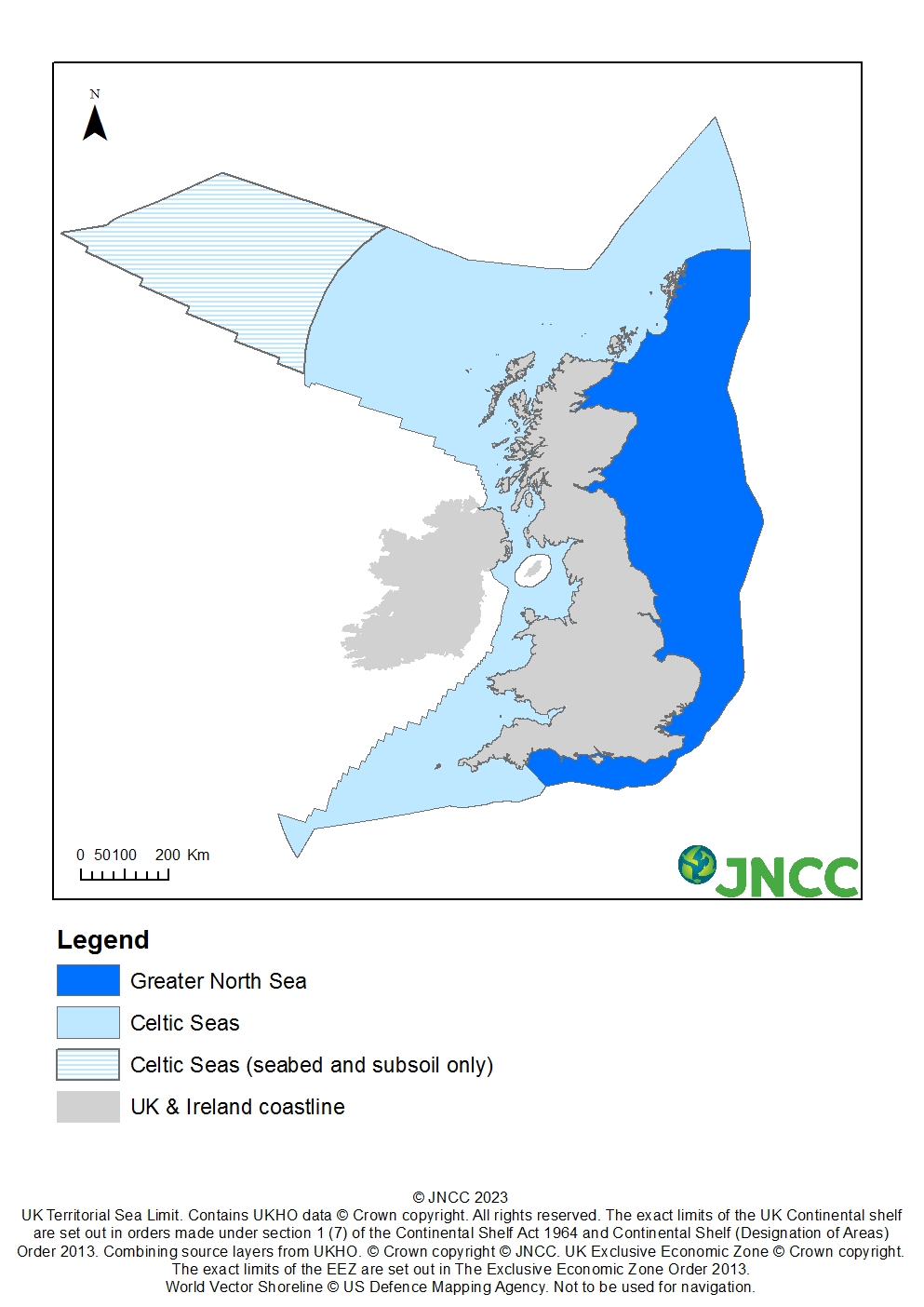
Figure 1 the area of UK waters to which the UK Marine Strategy applies. Source: https://moat.cefas.co.uk/introduction-to-uk-marine-strategy/
OSPAR
OSPAR is the Regional Sea Convention for the Protection of the Marine Environment of the North-East Atlantic. JNCC works in collaboration with UK agencies, international partners, and key stakeholders to deliver UK commitments to OSPAR. JNCC is part of the UK Head of Delegation for the OSPAR’s Biological Diversity Committee (BDC), and coordinates UK expert input into assessment, monitoring and protection of marine biodiversity.
JNCC contributes to OSPAR Assessments leading the development and implementation of indicators and assessments for marine mammals, marine birds, and benthic habitats. JNCC led the production of Thematic Assessments of marine birds and benthic habitats, which make up an important part of the evidence base of the latest OSPAR Quality Status Report 2023.
Additionally, JNCC provides advice within the Environmental Impacts and Human Activities Committee (EIHA) on underwater noise and on the delivery of UK lead tasks for the Regional Action Plan on Marine Birds (RAP-Bird) and Regional Action Plan for Benthic Habitats, in the context of North-East Atlantic Environment Strategy (NEAES) 2030.
JNCC contributes to the work of various Intersessional Correspondence Groups (ICG):
- Coordination of Biodiversity Assessment and Monitoring (ICG COBAM)
- Protection & Conservation of Species and Habitats (ICG POSH)
- Marine Protected Areas (ICG MPA).
- Underwater Noise (ICG-NOISE)
Latest OSPAR assessments
Intermediate Assessment 2029 (upcoming)
Other Media
Key biodiversity findings from our latest assessment of the North-East Atlantic, the QSR 2023.
Key benthic habitat findings from our latest assessment of the North-East Atlantic, the QSR 2023
Key marine bird findings from our latest assessment of the North-East Atlantic, the QSR 2023.
OSPAR IA 2017: JNCC Marine Assessment - Introduction to OSPAR
OSPAR IA 2017: Seabed Habitats
OSPAR IA 2017: Seabirds
OSPAR IA 2017: Marine Mammals
Environmental Indicator Framework
The Environmental Indicator Framework (EIF) is a suite of indicators describing environmental change relating to the ten goals of the 25 Year Environment Plan. The 25 Year Environment Plan and its subsequent update in 2023, the Environmental Improvement Plan (revised in 2025), set out government action to help the environment “regain and retain good health.”
JNCC contributes to multiple domestic marine indicators under the Seas and Estuaries theme. These indicators utilise data and assessment results from OSPAR and UKMS assessments to describe environmental change relating to the goals set out in the Environmental Improvement Plan and include assessment of the Seabed subject to high pressure from human activity, status of marine mammals and birds, condition of seafloor habitats, status of threatened and declining features, and seafloor habitats functioning. As part of this work, JNCC have developed a new indicator, published as an Official Statistic in Development, to shows changes in the status of vulnerable features flagged for protection.
JNCC also leads on another indicator under the EIF, K4: Extent and condition of terrestrial and marine protected areas in the UK Overseas Territories. This indicator measures the extent and condition of Marine Protected Areas (MPAs) across the UK and its Overseas Territories. This work provides essential evidence for assessing progress toward biodiversity conservation targets and supports statutory and international commitments. Annual updates ensure a consistent time series for tracking changes in MPA extent. Whilst a suite of indicators and indicator frameworks have been developed to help in the assessment of the ecological condition of MPAs, with data gathered in collaboration with UK administrations, Overseas Territories, and global partners.
Marine feature assessments
Marine feature assessments evaluate the condition and status of ecological features to inform management decisions and assess the effectiveness of conservation measures. JNCC plays a key role in several types of marine feature assessments:
- Habitats Regulations – JNCC undertake assessments of offshore Annex I habitats, Annex II species, and migratory birds under the Offshore Marine Regulations. These reports evaluate progress towards achieving Favourable Conservation Status for protected species and habitats.
- CBD/GBF: Red List of Ecosystems – JNCC undertake and support marine ecosystem feature assessments used to inform the A1 Red List of Ecosystems headline indicator published as part of the UK’s response to the Convention on Biological Diversity’s Kunming-Montreal Global Biodiversity Framework (CBD/GBF).
- OSPAR Threatened and Declining Features – JNCC contributes to regional assessments by developing methodologies and supplying UK data to support OSPAR’s work on threatened and declining species and habitats.
Published: .